







Is Bitcoin Entering a New Crypto Winter? A Cycle-Based Market Analysis
After the latest sell-offs, it is worth asking whether a new crypto winter has already begun and, if so, how deep it could go and how long it might last. So, is Bitcoin entering a new crypto winter?
Are we facing a new crypto winter?
As Mark Twain famously said, “History doesn’t repeat itself, but it often rhymes.”
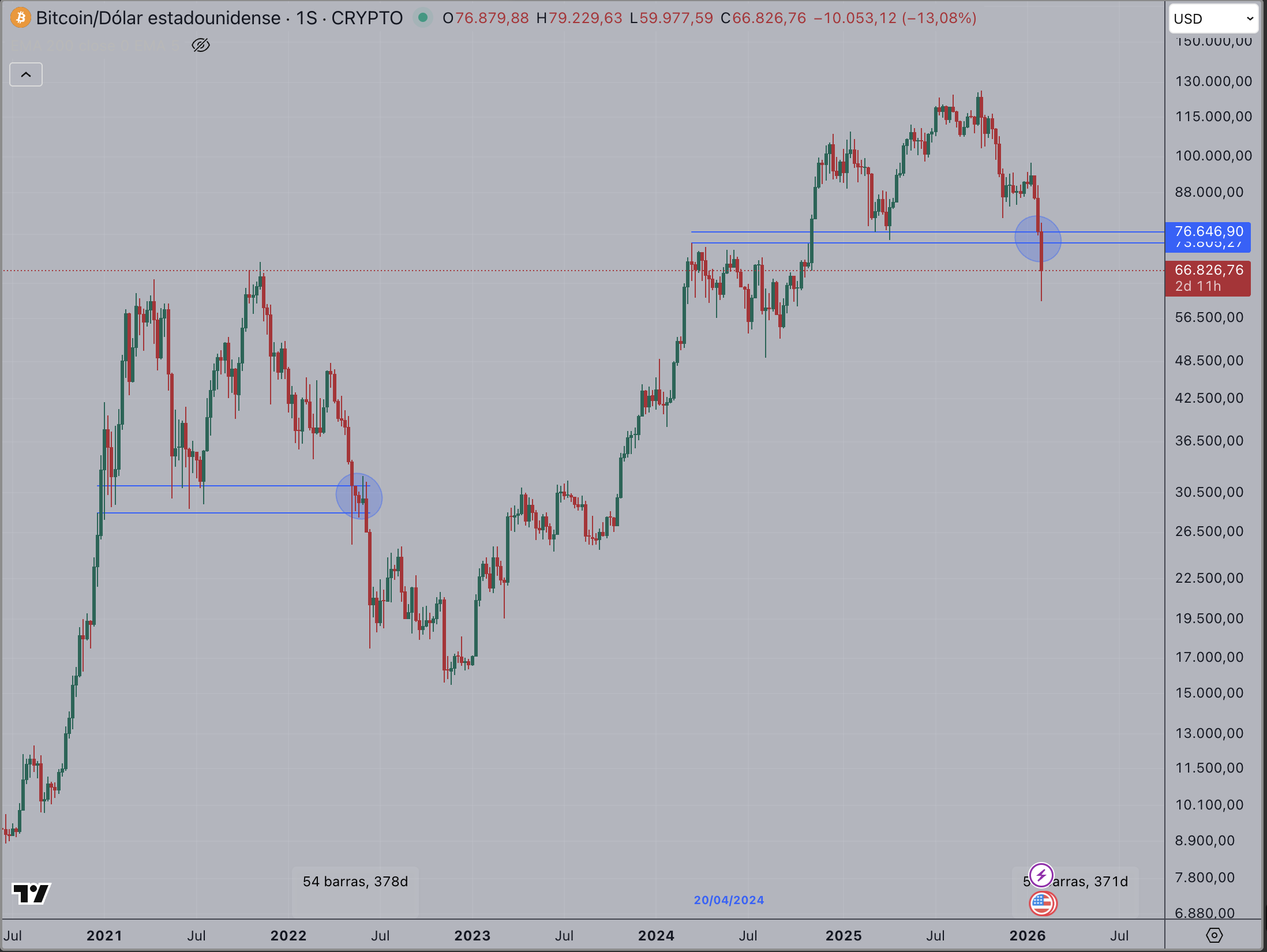
Looking at past cycles, it is hard to ignore the recurrence of certain concerning patterns, such as the breakdown of a major pivot zone following what appears to be a reversal formation (double top or cup-and-handle failure).
What is clear is that the sequence of higher weekly highs and higher weekly lows has been disrupted, and new lows are starting to be printed. This structural change suggests that, indeed, we may be entering a new crypto winter.
How far could it go?
By analyzing previous cycles, we can attempt to infer potential future price action.
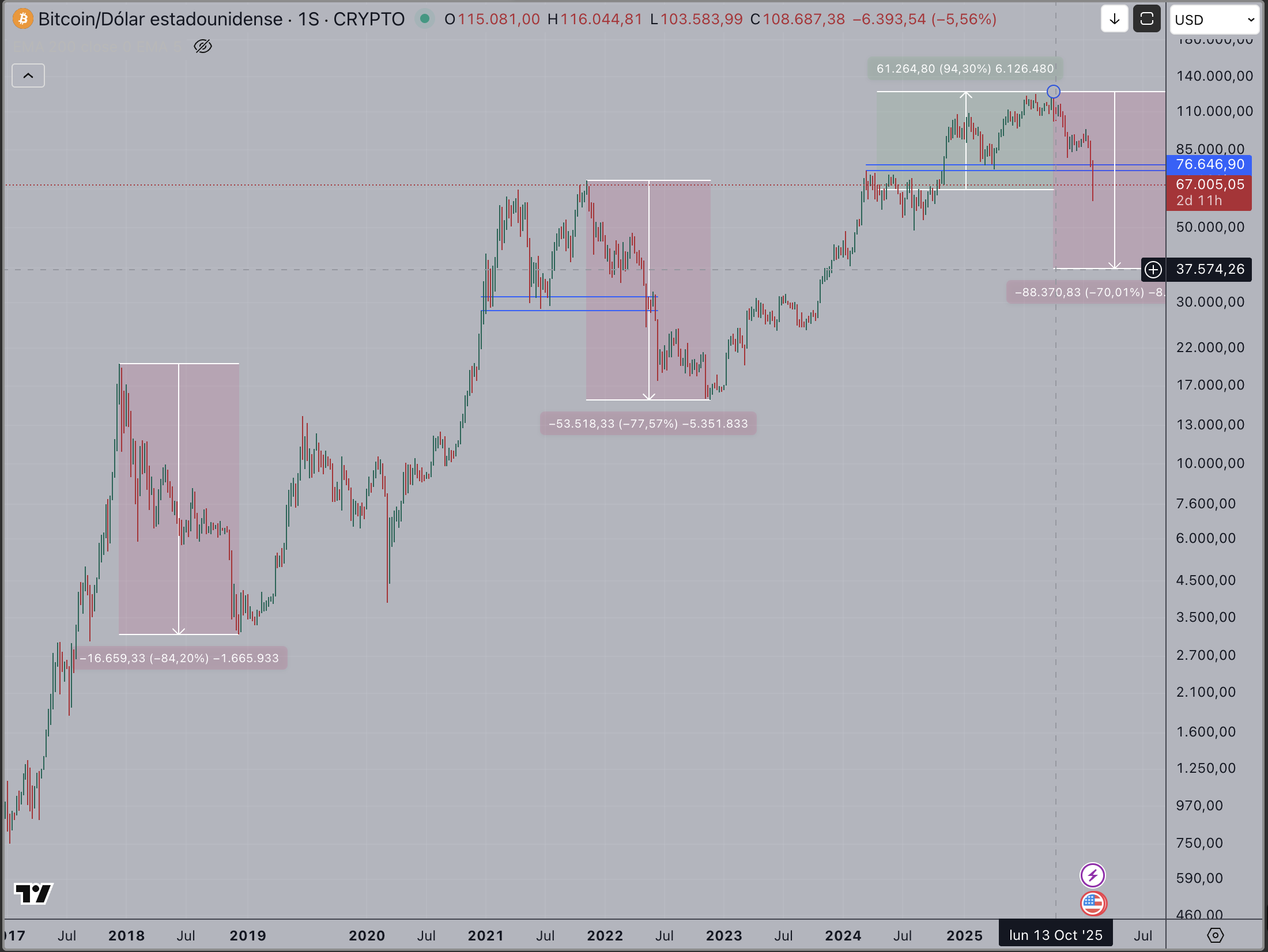
The crypto winter between 2017 and 2018 resulted in an approximate 84% drawdown in BTC from peak to trough. The 2021–2022 bear market ended with a decline of around 77%. While the statistical sample size is limited, it would not be unreasonable to expect a correction in the region of 70% this time. Such a move would place BTC around the $37k USD area.
How long could it last?
The 2017 crypto winter, measured from peak to trough, ran from December 17, 2017, to December 15, 2018—a total of 363 days.
The 2020–2022 crypto winter, again measured from peak to trough, extended from November 10, 2021, to November 21, 2022—lasting 376 days.
Using these references, and assuming that the high of the current bullish phase was set on October 6, 2025, we can infer that this new crypto winter could end sometime between:
- October 4, 2026, lasting 363 days, or
- October 30, 2026, lasting 389 days (376 + 13).
What’s the catch?
In trading, everything is relative—and even more so when dealing with an asset class with such a short historical record.
This analysis can be invalidated by countless factors, both financial and geopolitical. Therefore, what is presented here should be viewed as a hypothesis grounded in historical precedent rather than a certainty.
Ultimately, the only viable approach is to observe the ongoing evolution of crypto assets and, for those looking to anticipate market movements, consider a DCA (Dollar-Cost Averaging) strategy to build exposure gradually over time.
The ultimate truth is that no one knows what will happen next. We rely on probabilities and historical analogies to make informed assumptions, hoping they prove correct. For now, no one has a crystal ball capable of predicting the future.
Risk Warning: This article is provided for informational and educational purposes only and does not constitute financial, investment, or trading advice. Cryptocurrency markets are highly volatile, and past performance is not indicative of future results. Any views expressed are based on historical data and market observations and may change as market conditions evolve. Readers should conduct their own research and consider their financial situation and risk tolerance before making any investment decisions.